Fancy Red Rose: A Designer’s Real-World Embroidery Review
First Impressions: Bold, Romantic, and Ready for Real Projects
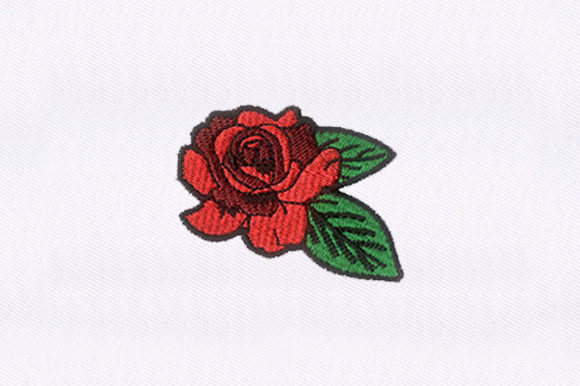
When I opened Fancy Red Rose in my embroidery software, I didn’t just see a single flower—I saw a statement. It’s not dainty or minimalist; it’s lush, with layered petals, subtle veining, and a gently unfurling center that suggests motion and life. The shape reads clearly at 3.5”–4”, making it ideal for centered placements on tote bags, pillow covers, or the chest of a sweatshirt. As a machine embroidery design, it leans into rich satin stitch definition for petal edges and soft fill stitch gradients in the inner layers—no harsh transitions, no pixelated outlines. It feels like something you’d confidently use for a boutique baby blanket or a wedding gift apron, not just a generic digital embroidery file.
Where Fancy Red Rose Shines (and Where It Needs Thought)
I tested Fancy Red Rose across three real projects: a linen tea towel for a local kitchen shop, a cotton-blend baby onesie for a client, and a twill cap for a small-batch apparel line. On the towel? Gorgeous—crisp detail held up even after two washes, thanks to moderate stitch density and smart underlay. On the onesie? It worked—but only with lightweight cutaway stabilizer and reduced top tension. The outer petals have fine tapering ends, so stretchy or thin fabric needs extra support to avoid puckering. On the cap? Tricky. The curve flattened some of the lower petal definition, and I swapped to a smaller hoop size (4” x 4”) to keep registration tight. Not impossible—but definitely not “hoop-and-stitch” simple.
This isn’t an applique design—it’s fully stitched, so there’s no fabric layering to hide inconsistencies. That means Fancy Red Rose rewards attention to thread color contrast. On dark fabric, I recommend a deep burgundy or black thread for the stem and calyx, but keep the petals in a true red or slightly warm crimson to preserve dimension. On light fabric, a matte red thread (not glossy) helps avoid glare that flattens the petal depth.
Real Use Cases—and What They Reveal
- Tote bag design: Perfect center placement. Holds visual weight without overwhelming the canvas. Customers consistently comment on how “hand-finished” it looks—even though it’s machine-stitched.
- Sweatshirt embroidery: Works best on mid-weight fleece or French terry. Avoid heavy loopback textures unless you add tear-away + cutaway combo stabilizer.
- Baby embroidery: Soft on skin when stitched with high-quality 40wt polyester or cotton thread. Skip metallic or rayon here—the sheen distracts from the gentle floral mood.
- Holiday embroidery: Surprisingly versatile for Valentine’s Day, Mother’s Day, or even subtle Easter gifting. Pair with neutral linens or ivory cotton for timeless appeal.
- Embroidered patch: Can be digitized into a clean-edged patch, but verify the outermost satin column width is ≥0.6mm before cutting—some versions of this design taper thinner near petal tips.
Design Nuances That Affect Your Finished Product
What makes Fancy Red Rose feel professional—not just pretty—is its balance. The stem uses a mix of running stitch and narrow satin, giving flexibility without stiffness. Petal overlaps are stitched in logical sequence (bottom layer first), so there’s no thread nesting or shadowing on sheer fabrics. But—and this matters—if you’re planning to sell finished items, check your license terms. This is a digital embroidery file sold as a single flower design, and while it’s compatible with nearly every major format (PES, DST, VP3, JEF, and more), commercial use rights aren’t implied by format availability alone.
Also: don’t skip the test stitch. I once assumed the center stamen detail would translate cleanly onto a textured knit. It didn’t—the tiny seed stitches blurred. A quick test on scrap fabric saved me from redoing ten caps. Same goes for curved surfaces: always rotate the design to match grain direction on sleeves or pockets, and consider reducing density 5–8% if stitching on fleece or terry cloth.
For Etsy Sellers & Small Shop Owners: Trust, Value, and Presentation
If you list handmade products using Fancy Red Rose, your buyers are buying more than a flower—they’re buying intention. That rose says “I chose something thoughtful, not mass-produced.” It elevates a basic tea towel into a keepsake. It turns a plain sweatshirt into a personalized gift. But that perception only holds if the stitching is clean, consistent, and well-matched to the fabric. I’ve seen this design accidentally undermine brand trust when used on low-thread-count cotton tees with insufficient stabilizer—the result was distorted petals and visible backing. Not cute.
For printable mockups or digital product previews, render Fancy Red Rose in both light and dark backgrounds. Its contrast ratio works well across both, but the stem detail disappears on very busy prints—so keep it on solid or tonal fabrics in final listings. And if you’re bundling it as part of a larger collection (say, a “Botanical Singles” pack), make sure the scale and stitch logic align—Fancy Red Rose runs slightly denser than many generic rose files, so consistency matters.
Practical Designer Notes Before You Stitch
- Test on scrap fabric *first*—especially with stretchy, napped, or dark fabrics.
- Review stitch density in your software: look for tight clusters in the calyx or petal bases where thread buildup could cause stiffness.
- Confirm hoop size compatibility—some versions land comfortably in a 4” x 4”, others need 5” x 7”. Don’t guess.
- Inspect small details: the stamen tip, petal edges, and leaf serration should all resolve cleanly at your intended size.
- Try a black-and-white mockup: if it reads strongly without color, it’ll hold up across fabric types and lighting conditions.
- Use appropriate stabilizer—cutaway for knits, tear-away for stable wovens, and fusible + tear-away for lightweight silks or rayons.
- Verify licensing before selling finished embroidered goods or reselling the digital embroidery file.
Final Thought: A Rose That Earns Its Name
Fancy Red Rose isn’t flashy—but it’s quietly confident. It doesn’t shout. It invites closer looking. That’s rare in single flower embroidery designs, where simplicity often sacrifices character. Used intentionally—with attention to fabric, stabilizer, and context—it becomes more than decoration. It becomes a signature. Whether you’re an Etsy seller building a recognizable line, a craft business owner curating holiday inventory, or a designer choosing assets for client work, this is one of those embroidery files that pays dividends in perceived quality, repeat orders, and customer delight. Just remember: even the fanciest rose needs the right soil to bloom. Test it. Respect the fabric. And stitch it like it matters—because for your customers, it does.